

There comes a moment in every woman’s spiritual journey when she realizes that the strength she has been searching for outside herself must first be awakened within.
We spend so much of our lives seeking love, protection, validation, security, and belonging. Yet the Vedic tradition reminds us that the Divine Feminine is not merely an external symbol of beauty or nurturing. She is Shakti, the sacred power through which life moves, transforms, creates, protects, and renews itself.
This is the essence of Navratri, the nine sacred nights dedicated to the worship of the Divine Mother.
Navratri invites us to turn inward, confront the forces that keep us disconnected from our spiritual nature, and cultivate the qualities that allow divine wisdom to flourish within our lives.
It is a celebration of the Goddess, but it is also an invitation to understand ourselves.
What Is Navratri?
The word Navratri comes from Sanskrit: Nava, meaning nine, and Ratri, meaning night.
Across nine nights and ten days, devotees honor the Divine Mother through prayer, mantra, meditation, fasting, sacred rituals, and devotional offerings.
One of the most widely observed forms is Sharad Navratri, celebrated in the autumn, culminating in Vijayadashami, a festival associated with the victory of dharma over adharma.
In the Shakta tradition, the Goddess is honored as the supreme Divine Reality, the source of creation and the power behind the universe.
Her many forms reveal different expressions of sacred feminine power: courage, purification, discipline, compassion, wisdom, protection, and abundance.
Navratri reminds us that spiritual transformation is not simply about becoming more peaceful.
Sometimes transformation requires us to become courageous enough to confront what is no longer aligned with our highest good.
Sometimes it requires surrender.
Sometimes it requires discipline.
And sometimes it requires the strength to stop abandoning ourselves.


The Nine Forms of Durga and the Journey Within
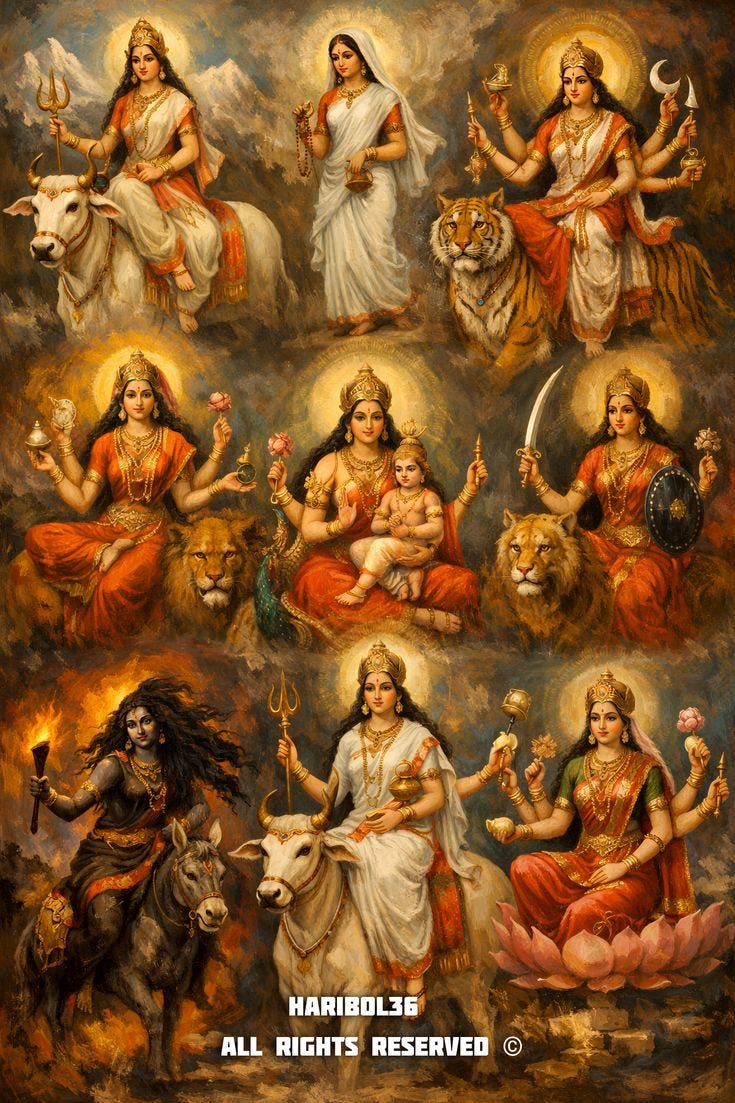
In the popular Navadurga tradition, each night is associated with a different manifestation of Goddess Durga.
These nine forms can also become a beautiful framework for personal contemplation.
Day 1 — Shailaputri: The Power of Grounding
Shailaputri represents steadiness, devotion, and the strength of the mountain.
She invites us to establish our foundation and remember who we are beneath the changing circumstances of life.
Day 2 — Brahmacharini: The Power of Spiritual Discipline
Brahmacharini embodies dedication, austerity, and the willingness to walk the spiritual path with sincerity.
She reminds us that transformation requires more than inspiration. It requires consistent practice.
Day 3 — Chandraghanta: The Power of Courage
Chandraghanta represents fearlessness and protection.
Her symbolism invites us to confront fear without allowing it to govern our decisions.
Day 4 — Kushmanda: The Power of Creation
Kushmanda is associated with cosmic creation and divine radiance.
She reminds us of the creative potential of Shakti and inspires us to participate consciously in the life we are building.
Day 5 — Skandamata: The Power of Divine Motherhood
Skandamata embodies maternal love, protection, and nurturing.
She invites us to reflect on the sacred responsibility of caring for life while cultivating wisdom and compassion.
Day 6 — Katyayani: The Power of Righteous Action
Katyayani represents strength, courage, and the protection of dharma.
She reminds us that spiritual femininity does not require passivity. Sometimes love must be expressed through decisive action.
Day 7 — Kalaratri: The Power of Transformation
Kalaratri is the fierce form of the Goddess who destroys darkness and removes obstacles.
She invites us to face the fears, attachments, and illusions that prevent our growth.
Day 8 — Mahagauri: The Power of Purification
Mahagauri represents purity, serenity, and renewal.
Her symbolism encourages us to release unnecessary burdens and return to simplicity, sincerity, and inner clarity.
Day 9 — Siddhidatri: The Power of Spiritual Fulfillment
Siddhidatri is associated with spiritual accomplishments and divine blessings.
She reminds us that the ultimate purpose of spiritual practice is not merely worldly achievement, but a deeper realization of our relationship with the Divine.
The Divine Feminine Is Not Weakness
One of the most important teachings we can contemplate during Navratri is that femininity and strength are not opposites.
The Goddess can be gentle, compassionate, beautiful, and nurturing.
But she can also be fierce, discerning, protective, and uncompromising in the defense of dharma.
These qualities do not contradict one another.
They reveal the fullness of Shakti.
For women navigating relationships, careers, motherhood, spiritual responsibilities, and personal transformation, this symbolism offers a powerful reminder:
You do not have to abandon your softness to become strong. And you do not have to abandon your strength to become feminine.
True spiritual growth asks us to integrate our different qualities rather than reject parts of ourselves.
Devotion should deepen our relationship with the Divine, not require us to erase our individuality or surrender our discernment.
Navratri as a Time for Inner Transformation
During these nine nights, I invite you to consider your spiritual practice as something more intimate than a series of external rituals.
Every offering can become an act of gratitude.
Every mantra can become an opportunity to steady the mind.
Every prayer can become a moment of surrender.
And every encounter with the Divine Mother can invite us to reflect on the qualities we are cultivating within ourselves.
You may wish to contemplate:
Where in my life am I being called to become more courageous?
What patterns am I ready to release?
Where have I confused love with self-abandonment?
What spiritual discipline would bring greater clarity into my life?
How can I honor both my softness and my strength?
What would it mean to place God at the center of my life?
We do not worship the Divine Mother merely to obtain material blessings.
We also seek her grace so that our hearts may become purified, our consciousness elevated, and our lives more aligned with dharma.
A Special Navratri Presentation for You
To accompany this article, I have prepared a PDF presentation exploring the sacred significance of Navratri and the Divine Feminine.
In this presentation, you can deepen your understanding of the Goddess and use these teachings as a source of inspiration throughout the nine nights.
[Attach Navratri PDF Presentation Here]
I encourage you to save the presentation, revisit it during your spiritual practice, and reflect on the qualities of the Divine Mother that feel most relevant to your life right now.
A Closing Reflection
The Goddess teaches us that transformation is not always comfortable.
Sometimes we must become like Durga, courageous enough to face what frightens us.
Sometimes we must become like Brahmacharini, disciplined enough to remain devoted to our path.
Sometimes we must cultivate the tenderness of Skandamata.
And sometimes we must surrender what no longer serves our spiritual growth.
But through all these expressions, the deeper invitation remains the same:
To remember our relationship with the Divine.
To live with greater consciousness.
To honor the sacred power of life.
And to allow our spiritual practice to transform not only what we believe, but how we love, choose, serve, and live.
May the Divine Mother bless your heart with courage, wisdom, devotion, and peace.
Jai Mata Di!
With love and devotion,
Vinodini Dasi
Vedic Astrologer | Spiritual Guide | Bhakti Practitioner
Gorgeous offerings Didī 🪔🌺🙏🏼 Venus Retrograde and Navaratri together called for deep introspection and reclaiming Shakti from within, I'm writing a lil article about how bridging decolonial politics and Jyotish can help embodiment and activism❤️